


Weather: After today's sizzler -- high of 92 expected -- Bronx air will cool back down into the low 80s tomorrow and should stay comfortably below 90 for the rest of the week.
Story of the Day: Bronx Kids Writing Around Town
This summer, the Bronx Council on the Arts is transporting Bronx youngsters to destinations outside of the Northern Borough for rich cultural experiences they otherwise wouldn't have the opportunity to enjoy. Before, during and after they go to galleries, museums or places like the Anne Frank Center in SoHo, the kids write about what they've seen and experienced. The goal of the Bronx Write Bus, says program director Maria Romano, is two fold: keeping kids stimulated and off the street and, at the same time, exposing them to cool cultural places and ideas. Good story from former BxNN intern turned Times scribe Andrew Boryga. The program ends next week.
Quick Hits:
Sad, bizarre crime story in the NY Post today about two clerks at the AutoZone on East 149th Street who chased after and caught a shoplifter yesterday. One of the AutoZone employees managed to wrestle the thief down and call police before the perpetrator turned the tables, for a minute anyway. Eventually, as onlookers told the employees to just let the guy go (why, they wondered, would they risk injury for a business they didn't even own?), the thief gave up the goods and departed before the cops arrived. Later, the Post found the alleged thief, who was sporting a shiner and other injuries. He said he was homeless and that "they didn't have to do that to me."
Tuesday, August 2, 2011
Bronx News Roundup, Tuesday, Aug. 2

Thursday, March 10, 2011
Bronx News Roundup, March 10
Rain, rain and more rain today in the Bronx and surrounding areas as the National Weather Service has issued a "coastal flood warning" as well as a "hazardous weather outlook" for the region. Get out your galoshes.
To the news!
Story of the Day:
A nasty five-alarm fire destroyed a Hunts Point apartment building yesterday afternoon, injuring more than a dozen people, including one person who was taken to the hospital with burns over 50 percent of their body. Eleven firefighters suffered injuries while battling the blaze, including two that were shocked by dangling wires obscured by the billowing smoke. Tenants and a deputy fire chief praised the efforts of New York's Bravest, who they say rescued at least a couple of trapped residents. "The fire was shooting out like a blow torch out of the front windows and into the side windows," said Deputy Chief Michael Falotico. Tenants from about a dozen apartments are now homeless. A cause has yet to be determined.
Quick Hits:
In January, the Bronx suffered a big spike in home foreclosures, with Williamsbridge and Baychester getting hit especially hard.
More on the South Bronx topping the list of the hungriest areas in the city.
Following an incident over the weekend in which a cab driver allegedly refused to take a group of young men to the Bronx and then ran into them after a stop at a police station, the city says it will crack down on cabbies who decline to drive passengers to outer boroughs.Gothamist has video of the problem in action. So does the NY Post:
More on the Bronx students who are in the running for an Emmy for their work on a Bronxnet show called "Open 2.0." (I knew we'd find some good news!)
A city resident files an iReport on CNN about the Botanical Garden's new Broadway-themed Orchid Show.
An ailing red-tailed hawk found on Webster Avenue in the Bronx was saved by veterinarians.
Angry former teachers have launched a campaign to oust Bronx Science principal Valerie Reidy.
A Bronx woman was convicted of aiding a mob hitman.
And finally, Kappy calls the Bronx DA race -- the only political race in the borough this year -- a snoozer and pleads for a "kamikaze" challenge to entrenched six-term incumbent Robert Johnson. He also rips off a couple of good burns the late Bronx comedian Mike DeStefano would have been proud of.
Friday, October 8, 2010
Bronx Housing Roundup: the mess of foreclosures
Tuesday, September 22, 2009
New from the Tremont Tribune

The September edition of the Tremont Tribune just hit the streets and is online now. A quick peek at what's inside:
Tenants in Belmont's Fordham Towers endured rats, broken elevators, and on-and-off heat and hot water after their building was bought by private investors in 2007. Now the building is in foreclosure - and housing advocates predict a wave of foreclosures among Bronx buildings bought in recent years by private equity funds who paid sky-high prices.
Arthur Avenue flaunted its food at the annual Ferragosto festival, and even Mayor Bloomberg stopped by for a taste.
The Bronx River Art Center recently filled the hole in the heart of West Farms Square - with an abstract sculpture conceived as a defense of New York City.
State Sen. Ruben Diaz is up in arms...over algae in Indian Lake.
Questions for Ivine Galarza, Community Board 6's longtime District Manager.
St. Barnabas Hospital renames an emergency room after an EMT who died on 9/11.
PLUS our monthly listing of community announcements and events, news briefs, political coverage, and more.
Monday, June 22, 2009
On the Housing Front
Here are a few Bronx-related housing stories for the beginning of summer:
The main topic for 2009 that will likely continue on for the foreseeable future is the issue of foreclosures in apartment buildings, especially those owned by private equity investors who gambled on increasing rents dramatically.
In the Gotham Gazette, Bronx-based freelance reporter Eileen Markey documents the Foreclosure Threat that Looms Over Thousands of City Apartments, including many in the Bronx.
Included in her piece is the worst-case scenario being played out a number of Bronx buildings owned by private equity investor Ocelot Properties, where the owners have walked away, the buildings are in complete disarray and a number of them have gone vacant.
Earlier this month, City Limits reported on the situation in these buildings and the efforts by the City and housing advocates to get the lender, Fannie Mae, to "take a more active role in ensuring upkeep of the properties."
University Neighborhood Housing Program has warned about these types of scenarios for years at our affordable housing forums. Two years ago at our forum on Shrinking Affordability, panelist Frank Anelante of Lemle & Wolff warned about the condition of much of the City's housing stock and that we would be seeing more and more buildings falling down, such as what happened in Brooklyn yesterday.
(The report from this year's forum on Envisioning the Future of the Red Zone contains an extensive collection of maps and charts focusing on the west Bronx including new housing, demographic, economic and real estate data.)
Finally, NY1 has a segment on how the City's housing department (HPD) is buying foreclosed homes to rehab and sell them at below-market prices.
Wednesday, April 29, 2009
Bronxites make a stink about water rates but wonder if the Water Board is really listening

Reporting and Opinion by Gregory Lobo Jost
Two members of Mayor Bloomberg's Water Board sat mostly silent in the auditorium of the Bronx Library Center on Kingsbridge Road yesterday afternoon. Their executive director (and acting DEP Commissioner) had left before even the first testimony was heard to attend to something that must have been very important upstate. (One wonders if they planned the hearing in the Bronx for that time so Mr. Lawitts could be a bit closer to his meeting 100 miles north of the City). The impending 14% water rate increase kept those in attendance agitated and the two board members mostly silent, save the new board chair Alan Moss's (in photo at center) recollections of growing up on Pelham Parkway to open up the hearing. Most of the talking by anyone on stage was done by the hearing officer (in photo at left).
Meanwhile, the same two City Council members from the Bronx once again attended the hearing. Councilman Koppell focused his testimony on how DEP could shrink the size of the hike by assuming a better collection rate, given the powers bestowed upon the agency by the City Council to sell water liens on multifamily properties and turn off service for delinquent single family homeowners. Councilmembers, of course, feel duped into giving DEP such powers since it is hasn't resulted in lower rate hikes like they were told. And since we are in a deep recession with the City's jobless rate spiking and foreclosures continuing to stay at or near all-time highs, collections will likely not improve; with each new double-digit water rate hike and the worsening of the City's economy comes the realization that many are unable to pay any of their bills, or must at least make the difficult decision between paying the mortgage, property taxes, heating oil, Con Edison, or water bill -- which would you choose? (UNHP's analysis last year showed 15-20% of homeowners at least one year delinquent on their water bills were already in foreclosure.)
Councilman Vacca made his points about how ironically conservation of water leads to higher water rates, and how the rates are really a hidden regressive tax that subsidize the City coffers. He focused on how DEP's budget continues to grow, while every other City agency must make drastic cuts. He implied that the Mayor may even encourage DEP spending increases because the more the agency pays in debt service on capital projects, the more money goes into the City's budget in the form of a rental payment.
Testimony was also heard from environmental groups who (rightfully) continue to harp on the poor decision making regarding the filtration plant, and from a private affordable housing owner and manager who warned of the toll these repeated increases will have on low income renters in the form of reduced services.
Three members of University Neighborhood Housing Program (including myself) testified as well. Included in my testimony was the suggestion for the Water Board to get a proportional cut of alternate side parking ticket revenue since, according to the Independent Budget Office, water rates subsidized street cleaning to the tune of $30 million last year. While somewhat in jest, I used this point to illustrate how the Mayor avoids raising taxes by bilking water rate payers to pay for City services.
UNHP's outreach coordinator, Jumelia Abrahamson, pointed out to the two present members of the Water Board that "the only thing that has gone up faster than the water rate over the past few years is the foreclosure rate." When this rate increase goes into effect, water rates will have gone up 60% in just four years, and will have more than doubled since 2001. To make matters worse, Councilmember Vacca pointed out that DEP is projecting double digit rate hikes for the next few years as well.
While legitimate suggestions were made on how to shrink the size of this year's increase, it is unlikely the Water Board will take any immediate action. Members who took the Mayor to task on the increase last year are no longer on the board.
Meanwhile, the results of the rate study commissioned last year are yet to arrive, meaning the Water Board does not have any recommendations about improving the structuring of the rate system that it will likely take seriously. If that's really the case, then the most useful suggestion of the afternoon may have come from Community Board 7 District Manager Fernando Tirado, who in the last testimony of the afternoon urged those in the audience to remember this rate increase when it comes time to vote in the fall.
The Daily News also covered the hearing.
Monday, April 20, 2009
Private Equity “Highlights” from the Bronx
The Real Deal picked up on the Botanical Square buildings and others owned by Hudson Realty Capital and managed by Pinnacle that, as reported on the Bronx News Network and the Norwood News are for sale at a loss (or were, as the listings have been pulled from the website). The article brings up the larger question of whether the buildings are over-financed, with varying responses from tenant advocates, owners, banker and realtor as to whether the income of the buildings can support the mortgage payments.
 The City Room blog also takes a look at these same buildings, focusing more on the conditions in the apartments. (Photo from the NY Times) Their piece highlights tenant advocates protesting outside a New York Community Bank branch, who they partially blame for the conditions.
Finally, seven buildings owned by another private equity group that may now be defunct have gone into foreclosure. According to foreclosure data from RealQuest, Fannie Mae commenced foreclosure filings on February 27 against 7 buildings owned by Ocelot Properties. The outstanding mortgage balance appears to be about $18 million for the 205 apartments, or about $87,000 per unit. If history is any guide, the conditions for tenants at 1744 Clay Ave, 1663 Eastburn Ave, 2254 Crotona Ave, 422 E 178th Street, 1271 Morris Ave, 806 E 175th Street and 1269 Morris Ave are likely to deteriorate before they improve.
Bronx Foreclosure Patterns for 2008
I picked up these maps at a Community Board 5 meeting a couple of months ago, and have been meaning to post them for a while.
They do a nice job of illustrating which neighborhoods have been most affected by the current foreclosure crisis (neighborhoods like Jamaica, Queens, and to a lesser extent, Williamsbridge in the north Bronx), and which have escaped unscathed (e.g. most of Manhattan and Riverdale). Feel free to add your own thoughts or questions about all of this in the comments section. To enlarge a map, click on it.

Friday, October 31, 2008
Canadian Radio on Foreclosures in NYC highlights Fordham Bedford
Canadian Broadcasting Corporation (CBC) Radio (think Canadian NPR) came to the Bronx last week to find out about how the financial crisis is affecting neighborhoods througout New York City. Reporter/Producer Deen Karim took a walk with me through some of the streets of Fordham Bedford to look at foreclosed homes and talk about the impact they are having on the neighborhood. Listen here at Part 2: Broken Dreams.
Tuesday, March 11, 2008
A Sign of the Slump?
Opinion by Guest Blogger Gregory Lobo Jost
New York City has seemed immune to the housing downturn afflicting most of the country, but there are plenty of signs that it may just be a matter of time. Foreclosure numbers continue to rise (at least in the outer-boroughs), many of the newly constructed infill housing (multiple 2- and 3-family homes on one lot) in the West Bronx sit vacant with For Sale and For Rent signs in the windows simultaneously, and now the latest from the Daily News: New housing construction down by one-third.
According to the article:
a new report from the city's housing and buildings departments shows building permit applications plunged 33% in the Bronx in 2007. Permits were issued for 3,104 new residential units in the Bronx last year, compared with 4,658 in 2006.
The ever-optimistic Borough President's Office counters that
the numbers do not represent a leveling off of local housing development, because there were still a record number of dollars invested last year — more than $925 million, compared with $713 million in 2006 and $237 million in 2002. Carrion's office said that more "substantial structures" were built in 2007 — including multi-family apartment buildings on smaller parcels of land and more elevator buildings, which cost more to build. The investment dollars also went into significant renovations of buildings. "It was a great year for housing in the Bronx — the fourth largest year in decades," said Carrion. "That's something to take notice."
Nonetheless it will be interesting to see how this plays out in the Bronx. No matter what, there will be some winners and losers. If housing prices do decline, current homeowners -- especially those in foreclosure who need to sell -- and banks will lose out. But if prices stay at the levels they are now, our affordability crisis will get worse as operating expenses like fuel and water continue to rise.
Thursday, February 21, 2008
Bronx Homeowner Aid Confab at Spellman H.S. Saturday
In an effort to stanch the tide of Bronx home foreclosures, State Sen. Jeffrey Klein is sponsoring a meeting Saturday where homeowners can meet with bankers to review their mortgages. The all-day session is form noon to 8 p.m. at Cardinal Spellman High School.
Wednesday, November 7, 2007
In the midst of growing foreclosure crisis, water shut-offs are ill-timed
The New York City Water Board will meet Friday morning to discuss a proposal to shut-off water service to over 8,000 single family homeowners behind on their water bills. There are also reports that the Water Board is considering a mid-year rate increase of up to 18%.
As foreclosures continue to climb, a coalition of nonprofit organizations that works with homeowners throughout the City plans to attend the little-publicized Water Board meeting Friday morning to demand a two-year moratorium on shut-offs for homeowners and to call upon Department of Environmental Protection (DEP) to improve communication and collaboration with the homeowner counseling groups in resolving unpaid bills. The groups also oppose any additional rate increase that may be on the table.
The proposal to shut-off water service to single family homeowners who owe at least $1,000 and are at least one year delinquent comes at the same time as foreclosure rates in the City are skyrocketing. Many of the homes targeted for shut-off are in the same neighborhoods victimized by high rates of subprime lending and foreclosures.
Water rates have already risen 22% in the past 18 months, and are projected to rise another 11.4% this coming July, as the DEP’s capital costs continue to escalate on major projects like the Croton Filtration Plant being built in Van Cortlandt Park in the Bronx.
The coalition of organizations attending the hearing include the New York Mortgage Coalition, the Association for Neighborhood Housing Development, Neighborhood Housing Services of Jamaica, CHANGER, Pratt Area Community Council, Community Assisted Tenant Controlled Housing, Neighborhood Housing Services of Staten Island, Neighbors Helping Neighbors, Harlem Congregations for Community Improvement, and University Neighborhood Housing Program.
The NYC Water Board meeting and hearing will take place Friday, November 9, 2007 at 8:30 AM in Room 123 of St. John's University Manhattan Campus (101 Murray Street).
Thursday, November 1, 2007
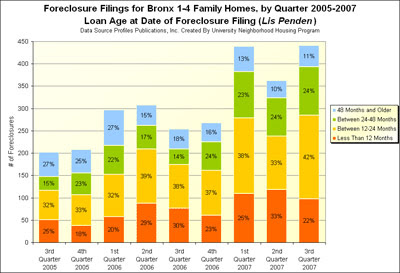
Most Bronx Loans in Foreclosure are Less Than 2 Years Old
Thursday, October 18, 2007
Local news from UNHP's Notes
Local nonprofit housing group University Neighborhood Housing Program's newsletter is out. Here's what you'll find in this edition of NOTES:
Water and Sewer: The News Just Gets Worse
An unprecedented 18% mid year water and sewer increase is proposed by DEP and could also lead to the establishment of stand-alone water lien sales.
Loan Fund Updates
To date, UNHP has made more than 100 loans with a value of over $4.5 million, and has recently updated its loan software.
New Resources Added to Community Resource Guide
Seven years after its creation, UNHP has developed a new section for CRG on Community Resources to help New Yorkers learn about the resources and benefits available to them.
A Remedy for Rising Foreclosures
The Northwest Bronx continues to display an alarming number of foreclosures, and it is against this backdrop that UNHP continues its outreach efforts to distressed homeowners.
BIP-ing the City
UNHP's Building Indicator Project Database will be automated this fall and will help identify distressed multifamily rental properties throughout New York City.
The West Bronx Online
There have been some exciting developments in the world of news about the West Bronx in the past year, including the West Bronx News Network and the West Bronx Blog.
Monday, October 1, 2007
A Remedy for Rising Foreclosures
Foreclosures in the Bronx jumped to an all-time high for the 3rd Quarter of 2007, according to Bronx nonprofit University Neighborhood Housing Program (UNHP). 441 one-to-four family homes went into foreclosure during the most recent quarter, topping the previous high of 438 set in the 1st Quarter this year.
While the majority of the foreclosures occurred in the East Bronx, both the Northwest Bronx and the South Bronx continue to display an alarming number of foreclosures, despite having fewer 1-4 family homes. In fact, the largest percent increase in the most recent quarter was in the Northwest Bronx, where filings jumped 39% to 74.
It is against this backdrop that UNHP will host its Homeownership Preservation Workshop, Thursday October 4th from 6:30 – 8:30 PM. Bronx homeowners will learn what they can do to avoid foreclosure, and have the opportunity to speak to foreclosure prevention counselors from local non-profits. In addition, two large area lenders, Chase and Washington Mutual, will also be on hand to speak with their borrowers. The workshop is free, and will be held at Concourse House, 2751 Grand Concourse at the corner of E 196th Street.
For more information please contact Eric Fergen, UNHP’s Outreach Coordinator at 718-933-2539 or fergen@unhp.org.
Founded in 1983, University Neighborhood Housing Program is a nonprofit organization working to create, preserve and finance affordable housing in the Bronx.
Wednesday, September 5, 2007
City's Foreclosure Prevention Efforts to arrive in the West Bronx for 2008
Just about two years ago the City began a pilot program to help distressed homeowners avoid foreclosure. The partnership, funded by a number of banks, Fannie Mae, Freddie Mac, and administered in partnership with a number of neighborhood and citywide housing nonprofits and legal service organizations, has been active in a number of targeted neighborhoods, primarily in Brooklyn and Queens. PACE, as the pilot is known, was rolled out to the northeast Bronx last year in partnership with Neighborhood Housing Services of the North Bronx.
Through the program, homeowners in targeted neighborhoods could call the City's non-emergency information line (311) and speak to someone about their mortgage problems. The intake person at the City would then refer the person out to the appropriate neighborhood group for counseling, loss mitigation, and/or legal assistance.
UNHP's report on the State of Homeownership in the Bronx (April 2006) offered a number of ideas for expanding PACE citywide so areas like the West Bronx (that have no homeownership counseling groups) could get access to resources. According to an article in City Limits, it looks like PACE will finally expand to the entire city in 2008 (and not a moment too soon).
In the meantime, West Bronx homeowners in distress can contact UNHP to find out about resources to help avoid foreclosure.
Thursday, August 23, 2007
How will the Subprime Fallout effect the West Bronx?
The recent dramatic changes in the real estate market -- ignited by the realization that making loans to folks who could never repay them was (also) bad for investors -- are slowly beginning to have an effect on the west Bronx housing market.
Up until very recently, New York had been mostly immune to the real estate downturn (dare I say bubble collapse?) occurring in the rest of the country. So while foreclosures are dramatically up in the City, the effects of them are mostly invisible (unless you know a victim), as troubled owners have been able to do a pre-foreclosure sale for more than the value of their mortgage (even if it's to a property-flipping 'we pay cash for houses'-type place). The main point here is that houses haven't been going vacant or boarded-up in recent years because there has been an out.
But while the City's economy remains strong, the troubles on Wall Street may be a sign that New York's real estate market may soon join the nationwide dive. Much of the subprime lending and "creative financing" that inflated this housing bubble is now drying up, as the secondary market (mostly Wall Street investors, but also Fannie Mae and Freddie Mac) are no longer interested in packaging or purchasing these riskier loans. That means that fewer potential buyers will have access to the type or amount of credit to pay the asking prices (pop! goes the bubble?).
Another similar issue that is especially relevant to the Bronx is the recent jump in jumbo mortgage rates. Because of concerns in the secondary market (the bank that gives you a mortgage often sells it so it can continue to make new mortgages) interest rates on mortgages above $417,000 have recently spiked. This phenomenon may not last, but if those rates do stay higher, buyers will have a harder time financing the two- and three-family homes for sale in the Bronx. In fact, some of the developers of the new-construction 3 family homes (often posted on craigslist.org) have begun dropping their asking prices lately, and many of these homes still have not sold.
If home prices in the Bronx fall below levels from two or three years ago, many homeowners going into foreclosure won't be able to sell for more than what they owe (most foreclosures are on mortgages made in the last two-five years). The result of this could be more properties actually going to auction, and potentially ending up owned by the bank until they could be resold. This is actually what is going on with distressing frequency across the rest of the country, especially in rust belt cities like Cleveland and Syracuse.
As for the specific foreclosure numbers, last week RealtryTrac reported on the rise in foreclosure rates comparing July 2006 to July 2007. The nation as a whole was up 93%, while NYC was up only 55%. The Bronx was up a measly 54.3%, from 208 filing in 07/2006 to 321 filings in 07/2007. UNHP's tracking of foreclosure data in the Bronx also shows increases in all parts of the borough, including the West Bronx.
On the multifamily side, Crain's is reporting that "financing for almost all large commercial and residential projects in the city has dried up," (subscription required) due to the lack of investor interest on Wall Street (another secondary market issue). However, this is mostly influencing deals outside of the Bronx (office and condo deals in Manhattan and parts of Brooklyn).
The majority of banks and thrifts that finance Bronx apartment buildings keep their mortgages in-house, so they may actually be able to pick up some of the business the secondary market is giving up, Crain's also reports. However, it is possible that many of these lenders will tighten their underwriting guidelines in current mortgage climate.
Overall, things remain fairly stable for owners of Bronx apartment buildings, in terms of their access to credit, but the question remains: What will happen in properties that have recently sold for high prices where the new owners need to raise rents to make their bottom line? Even in this recent strong economy, wages for most working class New Yorkers have stagnated, meaning more and more families pay upwards of half of their income on rent or are forced to double-up. An overall downturn in the economy may spell trouble for everyone, including new building owners who be forced to sell at a loss.
Friday, April 27, 2007
NYC's Water Woes
Also published on the Drum Major Institute Blog
11.5% in July; 11.5% next year; 11.4% the year after that; and 11.3% in 2010. Compounded annually, the 54% increase in water and sewer rates in New York City that the Water Board is projecting over the next four years will mean more maxed-out homeowners going into foreclosure, more affordable housing managers struggling to keep their buildings afloat, and (since all costs trickle down) higher rents for the millions of rent stabilized tenants, many who already pay half of their income on rent.
Why the large increases? According to the Water Board (appointed by Mayor Bloomberg) there are three main reasons: $23 billion in capital costs (about half of which are state or federally mandated) that are paid out of rates; the plethora of billing errors that prevent the Department of Environmental Protection (DEP) from enforcing collections resulting in more than $600 million in unpaid water bills; and the simple fact that water usage is down (they still need to collect a certain amount, so the more water we conserve, the more they’ll charge us for it!).
Add to this the fact that DEP will pay the City $135.9 million this year (and $154.8 million next year) in rent for use of land and infrastructure to deliver the water to City residents. So rate payers (and eventually tenants) pay more and more to DEP to pay the City rent to make sure we have a good chunk of that $4.4 billion dollar surplus the Mayor announced the other day. Does this make sense?
And don’t forget about the cost overruns at the water filtration plant being built on Bronx parkland, where the low-bid contractor has backed out because they know they can’t build it for what they had estimated. Rate payers (and eventually renters) will pay for the heavy federal fines being laid on the City each day a contractor is not in place – the amount is already over a million dollars. For the low-income neighborhood residents who already have to deal with the blasting, loss of parkland, and massive construction in their backyard, this is just another slap in the face.
So, enough about the reasons behind the rate increases; what is this really going to mean for low income households throughout the City? Most residents don’t think twice about water rates since owners pay them. But when the Rent Guidelines Board decides how much to raise rents each year for rent stabilized tenants, one of the main factors they look at is the rise in operating costs for owners. There’s no doubt that this four-year 54% increase in water (69% if you include last years 9.4% hike) will eventually get paid by renters in the coming years in a City where affordable rents are harder and harder to come by.
For owners and managers of affordable housing, the rate hikes mean an even more desperate struggle to reduce other operating costs to keep rents low while staying out of the red. As for new affordable housing projects, increased amounts of City subsidy will be necessary to defray these rising operating costs. Again, does this make sense?
And those who may be affected the most are the low, moderate and even middle income homeowners who are already dealing with volatile fuel costs, high insurance rates, and resetting interest rates on their ARMs (not to mention the victims of predatory lending). The percent of conventional homeowners (those living in a house) in New York City who pay more than 60% of their income on housing costs has jumped from 15.9% in 2002 to a staggering 19.2% in 2005. For these nearly one-fifth of all New York conventional homeowners, the projected water rate hikes could mean the difference between making their mortgage payments and going into foreclosure. How does this fit in with the City's foreclosure prevention work?
The hearings the Water Board has been holding in the five boroughs will not change any of the rate increases, and the press coverage on the overall situation and projected increases has been nonexistent. A real plan of action is to call on the City to convene a Water Summit with appropriate City leadership (including Bloomberg and/or Doctoroff) and nonprofit, real estate and lending community representatives to examine alternatives to this series of excessive rate hikes. The summit should tie into the Mayor’s 2030 planning and focus on environmentally friendly ways to reduce costs for rate payers. These should include looking to reduce capital costs or shifting them away from rate payers, and re-examining DEP’s rental payment to the City. Financial incentives for building owners who install gray water systems and green roofs should also be instituted, along with less costly incentives that can be utilized by homeowners, such as installing street trees, storm water tanks, porous pavement, and rain water harvesting systems.
If the City is really serious about preserving affordability, it needs to take water into account.
